
The Relational Nature of Time
While many in the United States are still struggling with the time jump of Daylight Savings Time, the Smoke in Our Hair exhibit, currently on display at the Hudson River Museum, showcased the myriad ways in which Indigenous understandings of time are cyclical and relational, rather than the liner and commodified Western perceptions of time. According to the Hudson River Museum website, each of the pieces on display explore “the nuanced layers of the past, present, and future within contemporary art by Native American, Alaska Native, First Nations, and Métis artists.”
Smoke in Our Hair highlights some of the most influential Native artists working over the last sixty years, many of whom have never had their works before exhibited on the East Coast. The art and artists span multiple generations, with a call to consider connections and disconnections between tradition and innovation.
Wood, Fire, and Smoke
The exhibit is organized into three sections—wood, fire, and smoke—with each gallery space referencing different elements of cycles. Here are a few select pieces from the exhibit, with information about each artist and their body of work:
Marie Watt, Companion Species (Remembering Song)
Marie Watt. Companion Species (Remembering Song), 2021. Reclaimed wool blankets, embroidery floss, thread. Gochman Family Collection.
Marie Watt (b. 1967) is an American artist and member of the Turtle Clan of the Seneca Nation of Indians. Her interdisciplinary work draws from history, biography, Haudenosaunee protofeminism, and Indigenous teachings.
Remembering Song was inspired by Marvin Gaye’s “What’s Going On?” and expands on its theme of unity to explore relationships between humans, animals, and ecosystems. Blankets are used as they are important in Native communities for ceremonial gifts and stories, and Watt and her collaborators stitched parts of this piece together during sewing circles held at Emory University in Atlanta and with Pacific Northwest College of Art students at Watt’s studio in Portland, Oregon. Collaborators were encouraged to share stories and learn from each other as they worked. The collaborative act of sewing allowed Watt to create a temporal bridge that linked ancestral teachings, popular music of her youth, present-day connections, and a shared vision of a sustainable future.
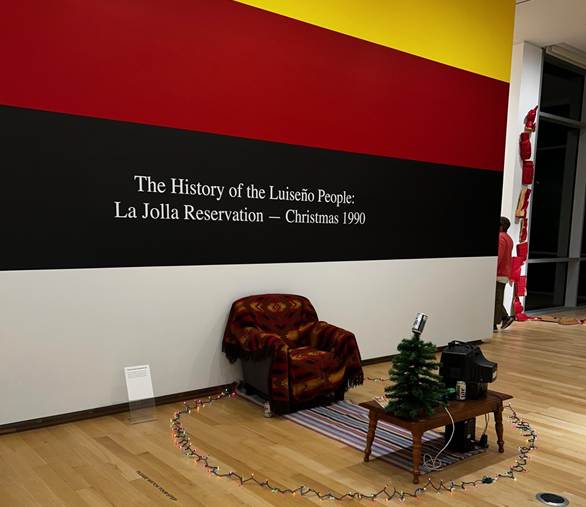
James Luna, The History of the Luiseño People: La Jolla Reservation, Christmas, 1990.
James Luna. The History of the Luiseño People: La Jolla Reservation, Christmas, 1990. Armchair, TV, DVD player, speakers, artificial Christmas tree, beer cans, telephone, Christmas lights, tabloid magazine, rug, and blanket. Gochman Family Collection.
James Luna (February 9, 1950 – March 4, 2018) was a Puyukitchum, Ipai, and Mexican American performance artist, photographer and multimedia installation artist who lived on the La Jolla Indian Reservation in Southern California. One of the most celebrated contemporary Native artists, Luna often unpacked racial stereotypes and unequal institutional power structures, using recurring themes of multiculturalism, alcoholism, and colonialism in his work. To communicate these difficult ideas, Luna often disarmed his audiences with candid humor and irony, as those played important, healing roles in his work. Luna’s artwork was known for exposing the outdated, Eurocentric ways in which museums have displayed Native American Indians as parts of natural history, rather than as living members of contemporary society.
This interactive piece allows viewers to sit in the chair, flip through a magazine, and watch the holiday specials airing in 1990 on the small television, allowing users to feel the sense of loneliness and alienation many Native American men experience.
Beau Dick, Bukwus Mask

Beau Dick. Bukwus Mask, date unknown. Cedar, leather, cedar bark, feathers, and acrylic paint. Gochman Family Collection.
Beau Dick (November 23, 1955 – March 27, 2017) was a Kwakwaka’wakw Northwest Coast artist and Chief who lived and worked in Alert Bay, British Columbia, Canada. He was a contemporary artist, activist, and hereditary Chief from the Namgis First Nation.
Dick’s work is rooted in Kwakwaka´wakw aesthetics and practices. His craftsmanship and artistry have been noted for being strongly influenced by traditional pieces and techniques but are unique for their incorporation of contemporary and Western influences. Dick’s masks were created for both ceremonial uses in the communities as well as for collecting. Rather than being preserved as pieces of art, many of Dick’s masks were given away or burned, returning them to the spirit world. Though his art often features ominous figures, like the mask displayed here, he conveys profound respect for cultural continuity.
Bukwus Mask challenges life’s inherent dualities—creation and decay, past and present—echoing the cyclical balance of existence.
Matthew Kirk, American Spirit

Matthew Kirk. American Spirit, 2021. Found wood, American Spirit cigarette, and metal. Gochman Family Collection.
Matthew Kirk (b. 1978) was born in Ganado, Arizona and is an enrolled member of the Navajo Nation. As a child he moved to Wisconsin with his mother where he lived until moving to Queens in 2006. Kirk has no formal art training and did not attend college or an MFA program but instead worked for over a decade as an art handler in New York City, which he would reference in his own abstract paintings, often incorporating Navajo petroglyphs. His choice of media is also influenced by his career as an art handler–he often incorporates recycled insulation foam, padding, wires, and other materials found on the street in New York City.
American Spirit is a playful reference to the well-known tobacco brand. A sacred plant for many Indigenous people, tobacco was commodified by colonial powers. Humor is a common Native resistance tactic, and here Kirk uses it to critique the tobacco industry’s long-standing use of Native American caricatures. The sculpture, though intentionally crude, juxtaposes the cigarette with reclaimed wood; highlighting the cultural abstraction and erasure perpetuated by cliched misconceptions of Native people as static and frozen in the past.
Supporting Indigenous Art and Culture
The exhibit is curated by independent curator Sháńdíín Brown, who is a PhD student, curator, creative and citizen of the Navajo Nation from Arizona, the 2023-2025 secretary for the Native American Art Studies Association (NAASA) and a curatorial consultant for the Gochman Family Collection.
Indigenous insight is engendered at the exhibition venue, and it is thanks to the the hard work of Art Bridges, the Forge Project, and the Gochman Family Collection, where the works in this exhibition are drawn from the collections of, that it is being brought to new markets. Art Bridges supports the creation of collection-based exhibitions of American art at museums of all sizes, working closely with partners to provide various levels of financial support for the direct costs associated with exhibitions, loans and collection sharing, with the goal of expanding access to American art, especially in regions where there is currently less access.
The Gochman Family Collection consists of a private lending collection of contemporary art focusing on work by Indigenous and American artists, with the guiding principle of supporting living artists and highlighting work that is anti-colonial and Indigenous-centered.
The Forge Project is a Native-led non-profit organization whose mandate is to cultivate and advance Indigenous leadership in arts and culture.
While so much of Native History is, as many of the artists on display as part of the Smoke in Our Hair exhibit have demonstrated, often static and frozen in time, a piece of history rather than an active part of it, it is incredibly important to honor and continue to support Indigenous artists and their work.
The exhibit is on view until August 31, 2025.
