

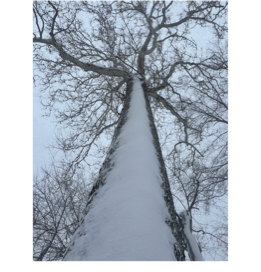
The Great Blizzard of ‘26 is upon us. This time, it’s a slow-moving nor’easter. Joe Rao first predicted 8 to 12 inches, but more recent weather models suggest ever higher totals. This winter will not quit, so enjoy it if you can.
It’s a wonderful time to go out and check on your favorite trees! There’s nothing better than a faithful oak or maple standing guard in a snowstorm! But be mindful of the potential for falling limbs in gale force winds. Arborists call them “widowmakers” — dead or weakened overhead branches that suddenly snap off. You won’t know what hit you. It’s estimated that every year up to 80 people in the U.S. die in these not-so-freakish accidents.
My series – A Tree Grows in Yonkers – has mostly been on hiatus during the winter, (although I seem to have a snowstorm exception, as I wrote another installment last month during the January 25-26 storm.) But whether I’m actively writing new tree stories or not, I’m always thinking about them. Whenever I’m out and about in town, I’m looking for the next great tree narrative. There are endless possibilities.
Season 2 will be about my recent discoveries, and hopefully readers will introduce me to the Yonkers trees they love, and I can tell their stories too.
But before we start up again, I thought it would be good to take a look back. Time to honor a few of those who came before.
The Great Odell Oak

Legend has it the Great Odell Oak was 1,000 years old when it started to show its age in the mid-20th century. Although it seems highly unlikely that it began life before the Battle of Hasting, it was undeniably a majestic and long-lived tree. Certainly 500 or 600 years was a distinct possibility—so perhaps it was around in Chris Columbus’s day.
The Odell Oak was deemed the oldest living inhabitant in Yonkers when the Westchester County Historical Society honored it with a plaque in 1952. Frank L. Walton, author of the strange and curious history Pillars of Yonkers – The Story of a Community from Tomhawks to Television, called it a “noble example of a perfect work of nature.” It was located near what was once the 14th tee of the Hudson River Country Club, a golf club founded by women, for women, which closed in the 1960s. It’s now part of the Executive Boulevard complex.
The Odell Oak was a massive white oak, growing in an open field. Such oaks are known for their short stocky trunks and broad-rounded, wide-spreading crowns, which can be wider than the trees are tall. Spreading white oaks are my favorite of this species because of their immense and gnarly horizontal limbs pointing in all directions. In the forest, all trees are more vertical, as they compete for space at the top of the canopy.
To this day, many of the stately older trees in Yonkers are mature white oaks. The winter is a perfect time to study their intricate skeletal structures and marvel at their silhouettes.
The Valentine Lane Chestnut

This is the house of John T. Duff, a real estate investor, at 123 Valentine Lane in the early 1900s. Nice house, but more importantly, in the foreground is the trunk section of a majestic America Chestnut.
Nicknamed the “redwood of the East,” at the turn of the 20th century, the American chestnut was a dominant, shade tree in Eastern U.S. cities. They lined streets and filled city parks, but a devastating blight first discovered in New York City in 1904 wiped out billions of chestnuts by 1940.
The Valentine chestnut was once designated the largest tree in Westchester County, with a circumference of 29 feet. It was believed to be between 700-800 years old, and probably older than the Odell Oak. From its vantage point in Ludlow Park, it would have witnessed the arrival of Henry Hudson’s ship the Half Moon as it began its journey of exploration up the river that bears his name.
Here’s a full picture of the same tree dying from the blight a few years later. You can see the Palisades in the background.

Oh, and one fun fact about the American chestnut. Although the blight wiped out the living trees, it did not kill the root structure. Thus, even today, it’s not uncommon to find American chestnut suckers sprouting in the forests – the living ghosts of the mighty chestnuts that once dominated our woodlands. Unfortunately, these infants indubitably succumb to the blight before reaching maturity.
The Fanshaw Oak

On Arbor Day in 1951, the City of Yonkers, led by its intrepid Arborist John Coyne (second from the left in light colored suit), installed a sign at the base of the Fanshaw Oak located on an island in the middle of the street near the corner of Fanshaw and Leighton Avenues. At the time, the Fanshaw Oak was deemed to be the second oldest tree in the City after the Odell Oak.
A search of the Herald Statesmen archives revealed that in 1953, the tree took its revenge on the passenger riding in a car that slammed into it, by dislocating her shoulder. Sometime in the 1970s, the tree may have been struck by lightning, but was still standing in 1970, when the archives go silent. The tree likely died and was removed in the 1980s.
In searching for clues about the Fanshaw Oak, I learned a lot about John Coyne. He was appointed arborist after WWII, and presided over the removal of many trees struck by Dutch Elm Disease and over 100 poplar trees along Hawthorne Avenue. Coyne was also instrumental in planting thousands of new trees to replace those that had died. He retired on April 6, 1964 and died two days later.

More Research Needed
There are many more stately trees that deserve mention here: The oaks at 409 North Broadway, 18 Dellwood Road, and the Underhill Oak (exact location unknown). There also must be a Yonkers story to tell of the demise of the great American chestnuts and elms.
My research took me back to the era when Yonkers was truly the “City of Gracious Living.” I now have a better image in my mind of what the tree-lined streets once looked like.
I imagine that Nodine Hill was a more breathable place when Elm Street was full of elms, and Oak Street full of oaks. I would have loved to have seen Hawthorne with its hundreds of poplars, and the huge American chestnuts that graced the riverside estates.
But my mind now turns to Season 2 of A Tree Grows in Yonkers. One day soon, the weather will be milder, and I’ll be able to start exploring the City in search of the great trees that still live. In my research I came across an article from 1970 that estimated that there were approximately 400 ancient oaks living in the City. I’m sure some of them still survive. It’s time to find them (and other species) and bring them to everyone’s attention. I hope you’ll come along for the ride.
A Tree Grows In Yonkers is a series by Phil Zisman. You can read more of the past series at The Yonkers Ledger. If you have a tree you love or would like Phil to cover, write him at Phil.Zisman@theYonkersledger.com

