
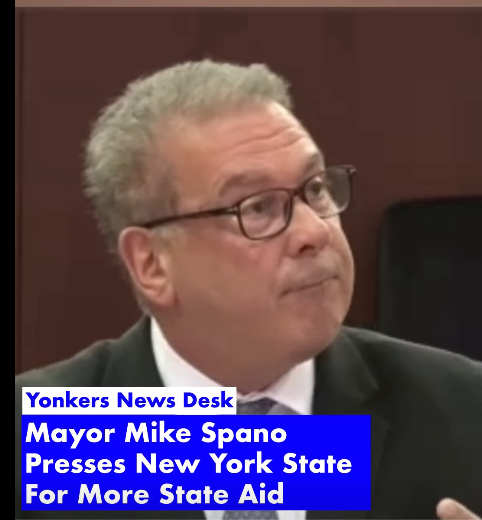
Before heading upriver for his annual “Tin Cup” performance in Albany to seek additional aid from the State Legislature, Mayor Spano rehearsed his message in a City Hall press conference, where not surprisingly, the Yonkers Ledger was the only media outlet present. (Local news coverage is a shell of its former self, but that’s a different story.)
The Mayor said the cost of running local government is rising rapidly and that Yonkers “taxpayers are exhausted.” He argued the State continues to shortchange Yonkers and warned that public schools and municipal services are at risk if more aid is not forthcoming.
This is not a new story. For more than 30 years, Yonkers Mayors and City Council members have complained that the State aid formulas for public schools and municipal governments treat Yonkers unfairly, leading to chronic budget deficits.
To address this inequity, the Mayor is asking the State to reclassify Yonkers as part of the high-cost New York City/Long Island region, and not part of the lower cost Hudson Valley. If this technical realignment is adopted, he says school aid could increase by as much as $47 million, depending on how it is phased in.
In addition, he wants the State to increase Aid and Incentives to Municipalities (AIM), which has been frozen for 16 years. A two percent increase in AIM would mean roughly $29 million more for Yonkers. Taken together, the City is seeking about $76 million in additional State aid this year.
One eye-opening statistic the Mayor frequently cites is that Yonkers will contribute $298 million to its public schools this year — about $40 million more than what Buffalo, Rochester, and Syracuse combined will contribute to their schools. According to the Mayor, Yonkers pays more because its schools receive less State aid than those sister cities. (Yonkers has approximately 24,000 students while the other three cities have a total of 65,000.)
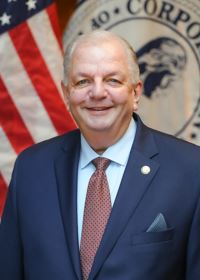
After the Mayor’s Albany presentation, I spoke with Yonkers Finance Commissioner John Liszewski, who said the City faces a substantial budget deficit next year: a potential gap of as much as $95 million for the Board of Education and $55 million for the municipal government, within a total budget exceeding $1.5 billion. However, he acknowledged these preliminary figures do not include some expected additional revenue, a property-tax increase, or the use of rainy-day reserves.
Liszewski said the Mayor remains in advocacy mode and is hopeful the State will again come through. Nonetheless, even if State aid falls short, the City will still balance the budget as legally required. When I asked him for a projected range for the property-tax levy, he would only say this is a tough budget year and the increase will exceed the statutory and constitutional two percent cap. (Cities may override the cap with a supermajority vote of the City Council.) I also asked how much of the rainy-day fund would be used, but he declined to provide a definitive answer.
As an aside, Liszewski noted the City’s DPW overtime and outside contractor costs for snow removal during and after the 2026 blizzard will exceed $1 million, to be paid from rainy-day funds. That figure does not include additional overtime the Police or Fire Departments may have accrued during the storm.
It may sound grim, but Yonkers is not the only New York city with a budget problem. Many large municipalities face similar fiscal cliffs. During his Tin Cup Day testimony, New York City’s mayor Zohran Mamdani, who was treated like a rock star, said his city faces a $7 billion deficit. Rochester and Syracuse officials pointed to some of the highest child-poverty rates in the nation as the reason why their cities needed more aid. Buffalo’s new mayor said his city mismanaged its finances and now seeks State authority to deficit-spend in order to recover, claiming it lacks funds even for necessary snow-removal equipment and basic infrastructure repairs.
As I listened to these tales of woe, I was reminded of Oliver Twist, with the mayors desperately pleading: “Please sir, can I have some more?” But unlike poor Twist, fortunately for Yonkers, the answer in the past has almost always been “yes.”
As we have experienced repeatedly, each year the projected large holes in the Yonkers budget somehow get filled. The State contributes slightly more than what is first proposed by the Governor, property taxes rise, rainy-day reserves are used more than officials would prefer, borrowing increases, fees and parking fines go up, and a handful of arcane budget maneuvers help close the gap. The status quo is preserved. Everyone declares victory, but nothing fundamentally changes. We muddle through another year, fully aware the process will repeat during the next budget cycle.
For several reasons, the same scenario is likely to play out again this year:
• First, it is an election year. Governor Hochul and State elected officials — including Yonkers own Senate Majority Leader Andrea Stewart-Cousins — want to demonstrate they can deliver for their constituents.
• Second, Wall Street had a banner year. The resulting personal-income-tax revenue from financiers’ bonuses has filled State coffers beyond expectations, giving Albany more money to spread around to municipalities.
• Third, Mayor Spano, who served ten years in the State Assembly, understands how Albany operates and will press every available lever to secure aid. In part, this explains his continued local support: when it comes to balancing the budget, he has delivered. State officials recognize the strength of the Spano political machine and want to remain on good terms with him.
These factors will likely produce what our local officials consider an acceptable increase in State aid. But the Mayor will not receive everything he requested — it is simply too large a lift given the competing needs across New York. When the City’s budget is finally settled, I predict a tax levy increase of about 4.58% That is squarely in the middle of Westchester County’s 2026 property tax increase of 3.7% and Mount Vernon’s 5.47% increase. Our finances are not as bad as Mt. Vernon’s, but not quite as strong as the County’s.
But once the budget is finally approved, probably sometime in May or June, the budget game for 2027 will begin again. In all likelihood, success next year will depend on the state of the national economy and whether the State of New York remains willing to continue to underwrite the rapidly growing costs of our expensive local government.

A link to the Mayor’s February 10, 2026 press conference can be found here.

