
I don’t know about you, but when I was in grammar school, we were taught that the first robin you saw in late winter was a sign of spring. I can still remember the stick figure drawing of the red breasted bird I drew to illustrate a poem I wrote: Spring is a New Beginning. I think I got help from the 1960s A.I. equivalent — Mommy — because I know I didn’t think of the title. Sadly, no copy of that masterpiece of poesy still exists.
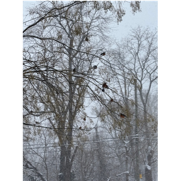
Anyway, it’s January 25th, and we’re in the middle of the blizzard of 2026. Earlier today, I went for a walk in the park just to feel the 10-degree temperature and the swirling snow on my face and to watch joyriders in their oversized Jeeps parading up and down the avenues.I came across approximately 30 robins roosting in a honey locust tree. In this freezing cold winter, this was no harbinger of spring. These birds were hunkered down and trying to survive.
Fewer and fewer robins actually fly south for the winter. Instead, they change their diet from worms to seeds and berries and stick around. They’re an adaptable bunch. So don’t be surprised when you see them in January. I hope our elementary schools have changed their curriculum.
Perhaps these Yonkers robins chose a honey locust because of their dried seed pods. If you look closely, you can see the pods hanging down from the top branches. Honey locusts are native to the Midwest, but over the last century or so have spread to the Northeast and are common in Yonkers. I’m sure many homeowners are familiar with the seed pods that litter the ground in the fall because they need to rake them up.
But did you know that honey locust trees also have brutally large thorns up and down the trunk and on the largest branches? Evolutionary biologists believe the thorns developed over thousands of years as a defense mechanism against prehistoric megafauna like ground sloths and mastodons that could severely damage the trees when seeking out the sweet seeds. The thorns were sturdy enough to puncture the toughest animal hides, but with the disappearance of these once fearsome beasts – hunted to extinction by our ancestors – the thorns serve little purpose. Now they are an anachronistic reminder of a different kind of hostile world.
Go out and see if you can find a honey locust tree, but if you do, under no circumstances should you try to climb it.
For those of you who pay attention to this sort of thing, I know I said that my Tree Grows in Yonkers series would be on hiatus until spring, but this story couldn’t wait.
This story is the ninth in a bimonthly series about trees in Yonkers. If any reader knows of a particular tree that they feel is worthy of an exposé, please contact me through the Yonkers Ledger at phil.zisman@theyonkersledger.com

